Roles say what. Grants say where.
Documentation for forty clients is forty clients' worth of risk. Trove KB scopes every read of company-owned data in the service layer, keeps secrets out of its own database entirely, and has a second sign-in step of its own that single sign-on does not replace.
Out of scope is "not found".
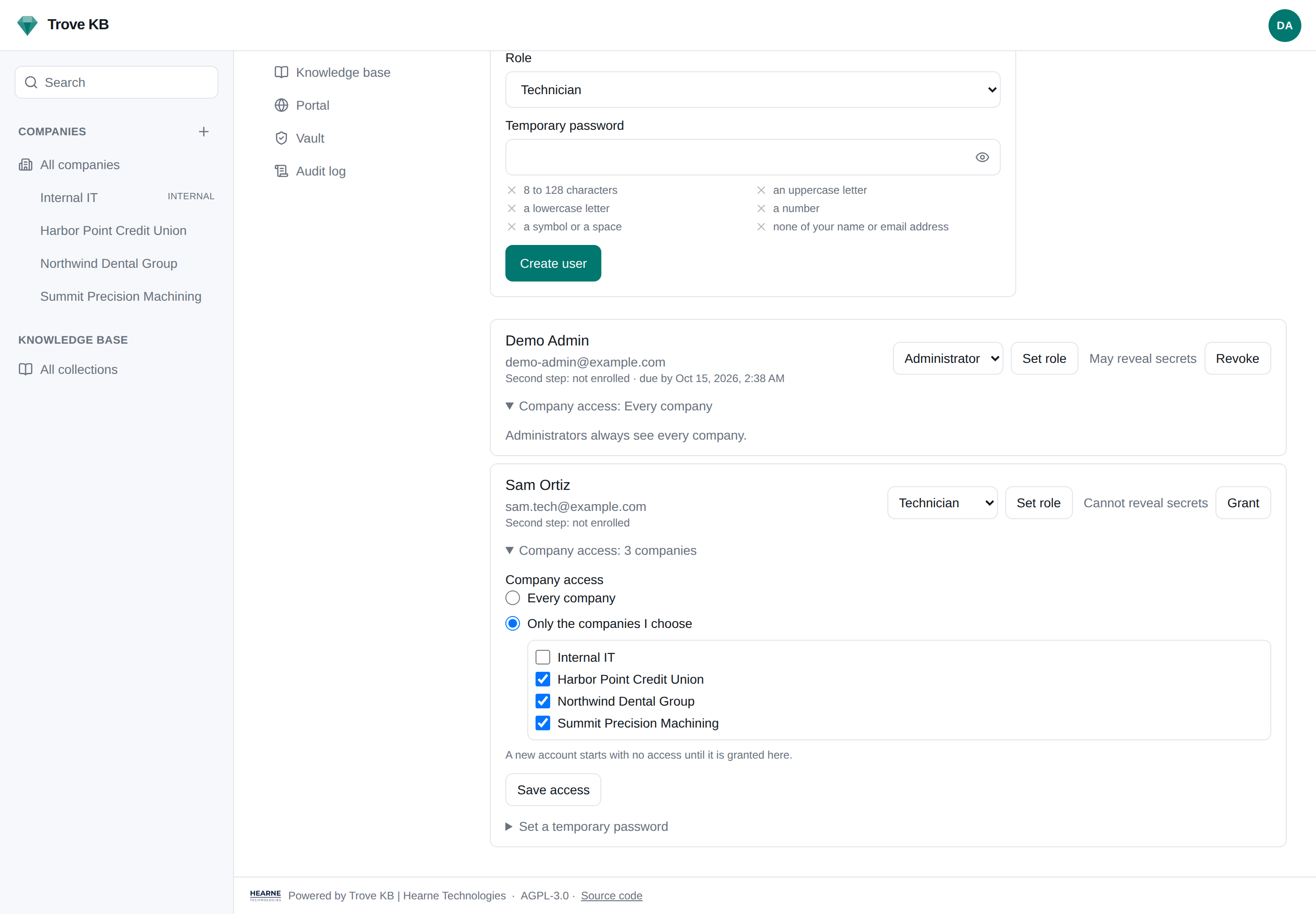
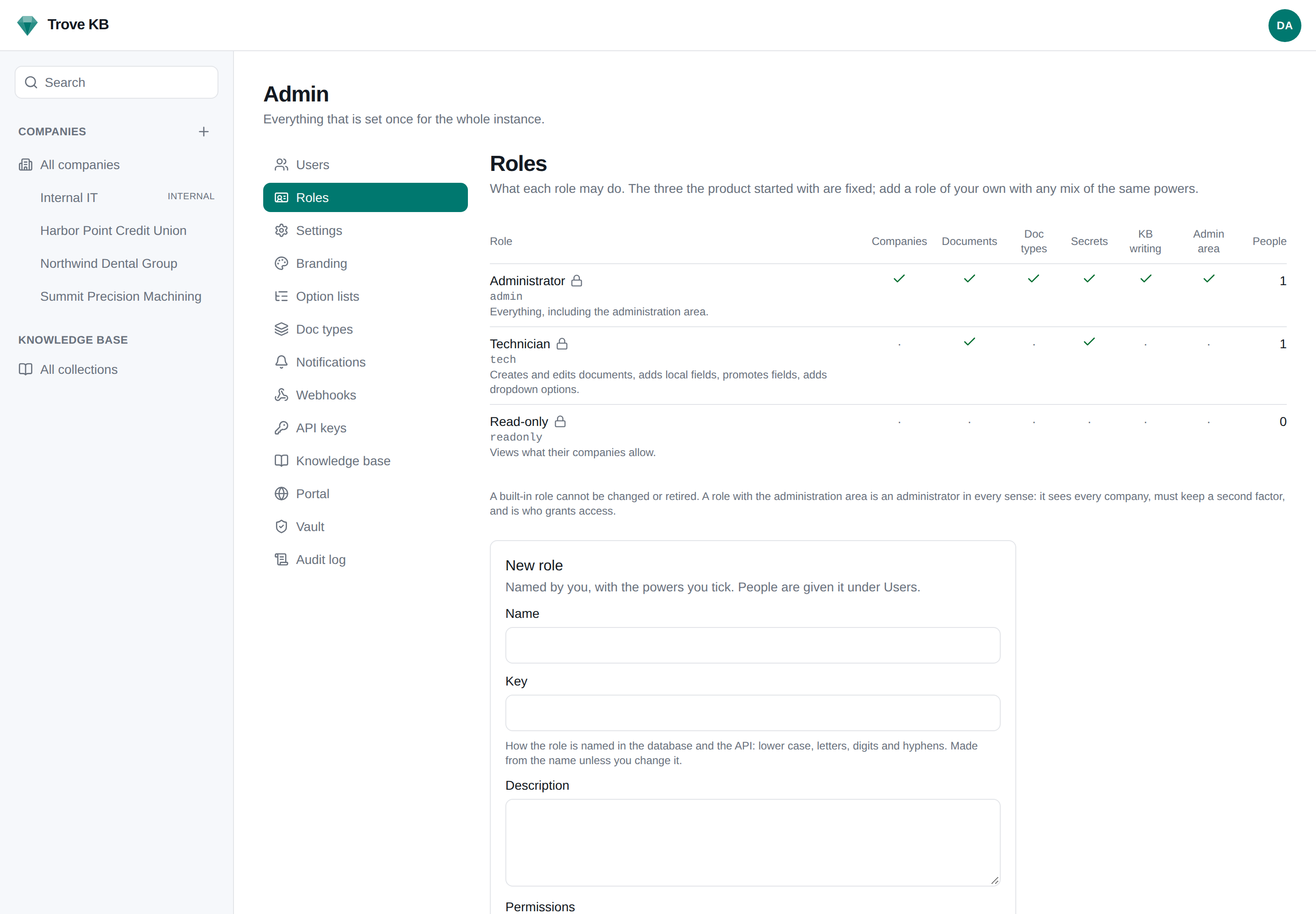
A role is a set of named permissions: companies, documents, doc types, secret fields, knowledge base writing, the administration area. The three the product starts with (admin, tech, readonly) are fixed; under Admin → Roles you add your own with any mix of the same powers. A role holding the admin area is an administrator in every sense.
A user or an API key sees every company or only the ones granted. A new account starts with none until an admin grants some, so an SSO user signing in for the first time reads nothing.
Anything outside the granted set answers "not found", never "forbidden", because saying a company exists but is not yours is itself a disclosure. Holds across search, backlinks, exports, attachments, deep links, the API, and MCP.
Scope is read from the database on every request, not from the session, so revoking a grant applies on the next page load.
Append-only. Every save, reveal, grant, key, and second-factor change, with who and when. A viewer under Admin.
Its own second step.
Local accounts hash with Argon2id. API keys are random 32 bytes, shown once, stored as a SHA-256 hash, looked up by prefix. Rich text is sanitized server-side on every write. CSRF protection on session routes and rate limiting on auth and the API are on by default.
8 to 128 characters with mixed classes, never the person's own name or address, never one in a known breach (checked by k-anonymity against Pwned Passwords, so the password never leaves the server). Ten wrong in a row closes the account for fifteen minutes.
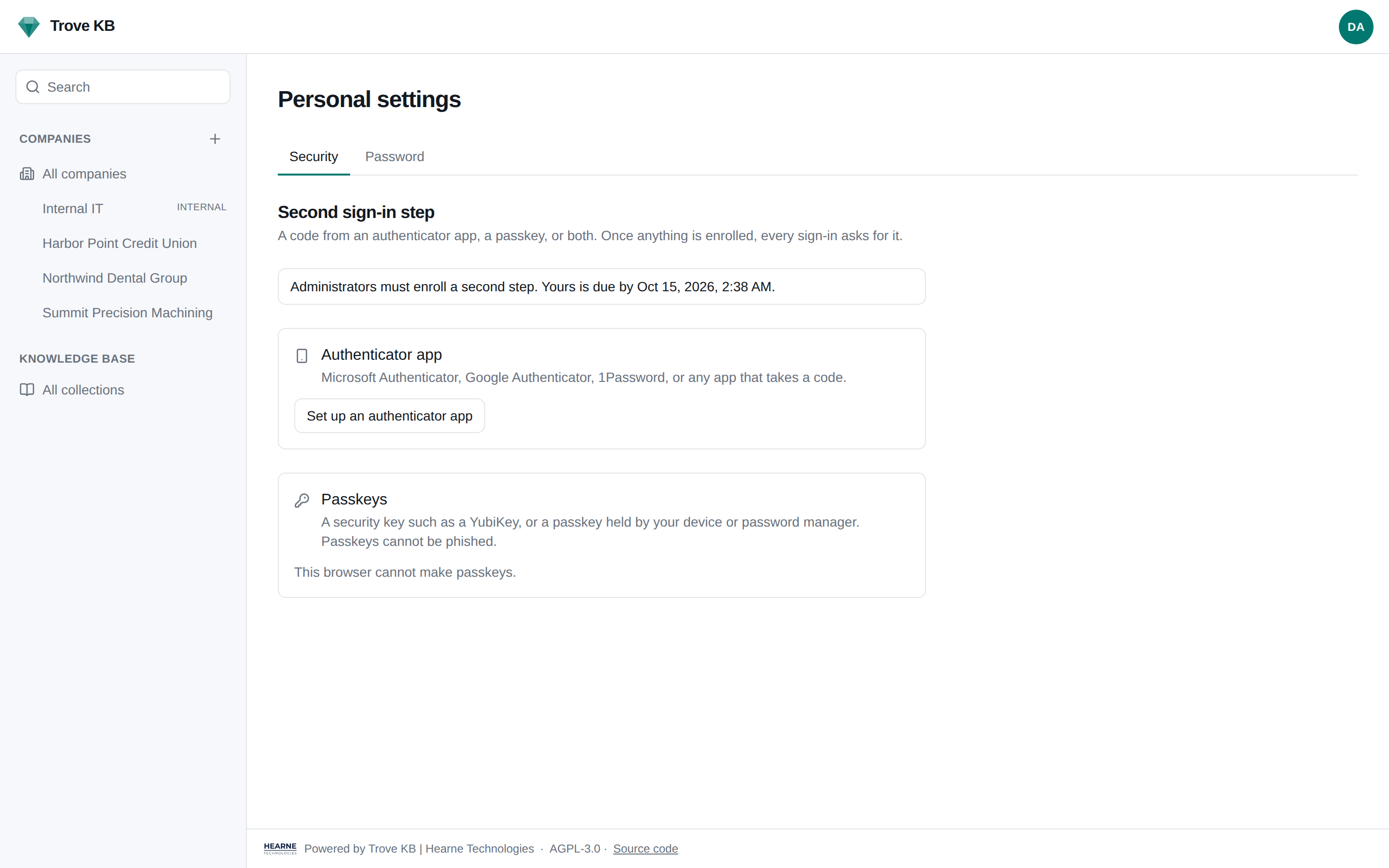
Authenticator app, passkeys (a YubiKey, or the one a phone or password manager holds), or both, with ten single-use recovery codes. Required for admins within a week; offered to everyone.
The pages that issue API keys, change people, or change security settings ask for the second step again after fifteen minutes.
OIDC with discovery: Entra ID, Google, Authentik, Keycloak. Three env vars. SSO in front does not stand in for the second step; it composes with it.
A reset link by mail when SMTP is set; otherwise an administrator sets a temporary password that must be changed at the next sign-in. Lost everything? Another admin puts it right from Admin → Users.
Typed by their bytes.
Images, PDF, Word, Excel, PowerPoint, CSV, Markdown, and plain text, up to a limit you set, on a local volume, an NFS share, or any S3-compatible bucket.
- →What a file is comes from its own bytes. Renaming an executable to .png does not get it in.
- →Macro-enabled and legacy Office formats are refused whatever extension they arrive under.
- →HEIC and HEIF photos are converted to JPEG as they are stored, so a picture from a phone opens for everyone.
- →Downloads are always served as attachments with nosniff, so an uploaded file can never execute on the site's origin.
- →Logos are PNG, JPEG, or WebP. SVG is refused, because an SVG can carry script and a logo is drawn on every page.
Nothing open to the internet.
Bind the port to 127.0.0.1 and publish it through a Cloudflare Tunnel, with Access in front for a second gate if you like. The vault sidecar never publishes a port at all. The public knowledge base goes on its own hostname behind a proxy that passes nothing else.
A backup is a pg_dump, a tarball of the uploads volume, and your .env. It never contains a secret, because the database never held one.
Read the source. It's AGPL.
Every rule on this page is a line in the service layer and a test in the e2e suite.